Κυριακή 25 Σεπτεμβρίου 2022

Co-administration of Oral Cholera Vaccine with Oral Polio Vaccine among Bangladeshi Young Children: A Randomized Controlled Open Label Trial to Assess Interference

alexandrossfakianakis shared this article with you from Inoreader

cid_ogimage.png

Abstract
Background
Cholera remains a public health threat for low- and middle-income countries, particularly in Asia and Africa. ShancholTM, an inactivated oral cholera vaccine (OCV) is currently in use globally. OCV and oral poliovirus vaccines (OPV) could be administered concomitantly but the immunogenicity and safety of coadministration among children aged 1-3 years is unknown.
Method
We undertook an open-label, randomized, controlled, inequality trial in Dhaka city, Bangladesh. Healthy children aged 1-3 years were randomly assigned to one of the three groups: bivalent OPV (bOPV)-alone, OCV-alone, or combined bOPV + OCV and received vaccines on the day of enrollment and 28 days later. Blood samples were collected on the day of enrollment, day 28, and day 56. Serum poliovirus neutralizing antibodies and vibriocidal antibodies against V. cholerae O1 were assessed using microneutralization assays.
Results
A total of 579 children aged 1‒3 years were recruited, 193 children per group. More than 90% of the children completed visits at day 56. Few adverse events following immunization were recorded and were equivalent among study arms. On day 28, 60% (90% Confidence interval, 53%-67%) and 54% (46%-61%) of participants with co-administration of bOPV + OCV responded to polioviruses type 1 and 3 respectively, compared to 55% (47%-62%) and 46% (38%-53%) in the bOPV-only group. Additionally, >50% of participants showed a ≥4-fold increase in vibriocidal antibody titre responses on day 28, comparable to the responses observed in OCV-only arm.
Conclusions
Co-administration of bOPV and OCV is safe and effective in children aged 1-3 years and can be cost-beneficial.
View on Web

Application of Cinnarizine in Migraine Prevention: A Systematic Review and Meta‐analysis

alexandrossfakianakis shared this article with you from Inoreader

Abstract

Objective

To investigate and analyze the available data on the prophylactic effectiveness of cinnarizine in migraine disorder.

Background

Cinnarizine has demonstrated encouraging potential in preventing the attacks of migraine. Therefore, we opted to evaluate whether its sole administration leads to positive outcomes.

Methods

The PubMed, Scopus, Web of Science, and Embase databases were searched for English-only original interventional studies published until April 2022, then screened for relevancy and eligibility. The resulting data from the included studies, including the primary(i.e., headache episode frequency, intensity, duration, monthly timing, and analgesic intake frequency) and secondary(i.e., reported adverse events, quality of life, and activities of daily living) outcome changes compared to placebo and active controls(e.g., sodium valproate and propranolol) were then recorded by two independent assessors. Ultimately, these data were synthesized qualitatively and quantitatively(achieved by determining the mean difference via the random-effects model).

Results

A total of 10 studies comprising seven randomized controlled trials and three quasi-experimental studies were included. Compared to placebo, cinnarizine demonstrated significant improvements in migraine episode frequency(Mean difference= -3.10; Confidence interval=[-3.33, -2.88]; P-value<0.001; I2 <0.001%), and intensity(Mean difference= -1.54; Confidence interval=[-2.08, -0.99]; P value<0.001; I2 <37.97%). Moreover, cinnarizine led to similar or better results when compared to active controls, including sodium valproate, topiramate, and propranolol.

Conclusions

Cinnarizine can be considered a safe and effective medication for migraine prophylaxis. However, the relatively small sample size made reaching a definite conclusion impossible. Therefore, a higher number of randomized controlled trials are recommended to be taken place to clarify the situation further.


View on Web

Effects of vitamin D supplementation on muscle function and recovery after exercise‐induced muscle damage: a systematic review.

alexandrossfakianakis shared this article with you from Inoreader

ABSTRACT

Background

Vitamin D is essential for the optimal health of the skeletal system. However, this vitamin is also involved in other functions of the human body, such as muscle, immune and inflammatory ones. Some studies suggest that adequate levels of vitamin D support muscular function during exercise and accelerate recovery because they reduce specific pro-inflammatory cytokine levels, but those results have not always been observed. Therefore, this review aims to evaluate the effects of vitamin D supplementation on inflammation, oxidative stress and recovery after exercise.

Methods

This systematic review was conducted using the PRISMA guidelines. A literature search of SPORTDiscuss, PubMed, Web of Science and Scopus was performed from inception through February, 2021. The articles' methodological quality was assessed with the PEDro scale.

Results

After the application of the inclusion and exclusion criteria, 11 eligible articles were included. A ll the studies were considered of moderate methodological quality. Ten studies involved regular vitamin D supplementation for more than 7 days, and one study performed acute vitamin D supplementation 24 h before exercise.

Conclusions

The existing evidence suggests that vitamin D supplementation for periods of more than 1 week with a minimum dose of 2000 IU/day appears to be an efficacious strategy for attenuating muscle damage and inflammation after exercise. The potential positive effects on muscle function, muscle pain and oxidative stress need to be confirmed with new investigations. Further research is also required to clarify the adequate vitamin D dosage to obtain positive effects without adverse effects.

This article is protected by copyright. All rights reserved.

View on Web

Blood counts in children with Down syndrome

alexandrossfakianakis shared this article with you from Inoreader

Abstract

Background

Children with Down syndrome (DS) are more likely to have hematologic and immunologic abnormalities compared to their typically developing peers, but normal ranges have not been defined. The goal of this study was to create references for complete blood counts (CBCs) in patients with DS.

Methods

A retrospective investigation of 355 (male = 196, 55.2%; mean age = 6.49 years, SD = 5.07) healthy pediatric patients with DS who received a CBC between 2011 and 2017 as part of their medical care at a single, large, pediatric teaching hospital. Control data on 770 healthy patients without DS were included. Descriptive statistics were performed on demographic and clinical characteristics. Kruskal–Wallis H tests, nested analysis-of-variance tests, and t-tests were run to determine the significant associations.

Results

Age-related normative curves for healthy children with DS outlining 2.5th, 25th, 50th, 75th, and 97.5th percentiles are provided for total white blood count, hemoglobin concentration, hematocrit, mean corpuscular volume, and platelet, absolute neutrophil, absolute lymphocyte, eosinophil, monocyte, and basophil counts. Statistical differences were found between children with and without DS receiving care at the same hospital based on matched age/sex groups.

Conclusions

This study demonstrates that patients with DS have different reference ranges for multiple blood counts compared to those without DS, creating a new resource for pediatricians to refer to when evaluating CBCs in this population.

View on Web

Longitudinal use of patient reported outcomes in pediatric leukemia and lymphoma reveals clinically relevant symptomatic adverse events

alexandrossfakianakis shared this article with you from Inoreader

Abstract

Background

Leukemia and lymphoma (LL) are the most common cancer diagnoses of childhood with high survival rates, but not without impact on the child's functioning and quality of life. This study aimed to use patient-reported data to describe the symptomatic adverse event (AE) experiences among children with LL diagnoses.

Methods

Two hundred and fifty seven children and adolescents aged 7–18 years with a first LL diagnosis completed the Pediatric Patient-Reported version of the Common Terminology Criteria for Adverse Events (Ped-PRO-CTCAE) and Patient-Reported Outcome Measurement Information System (PROMIS) Pediatric measures before starting a treatment course (T1) and after the treatment (T2).

Results

Fatigue was the most severe AE (68.1% at T1; 67% at T2) and caused the most interference over time. Gastrointestinal AEs were also quite common (e.g., nausea 46.3% at T1 and 48.9% at T2; abdominal pain 42.4% at T1; 46.5% at T2). In general, symptoms were present both at T1 and T2 and did not change significantly in severity or interference. The prevalence of AEs varied by LL disease group (e.g., nausea was most common in acute lymphoblastic leukemia (ALL), fatigue was most severe in ALL and Hodgkin Lymphoma (HL), acute myeloid leukemia had the fewest AEs).

Conclusion

Despite current supportive care regimens, many children with LL continue to report fatigue, pain, insomnia, and gastrointestinal symptoms as the most frequent or severe symptoms during therapy.

View on Web

Clinical‐based oral rehabilitation programme improved the oral diadochokinesis and swallowing function of older patients with dementia: A randomized controlled trial

alexandrossfakianakis shared this article with you from Inoreader

Abstract

Objective

To evaluate the effectiveness of a clinical-based oral function intervention on oral function and care behaviours in older patients with mild dementia.

Method

Participants were randomly assigned to the experimental group (EG) and control group (CG). Both groups received a leaflet on oral health-related knowledge, and the EG also received an oral function intervention, which was a brief one-on-one lesson concerning oral exercise and preventive oral care. Oral exercise included turning the head, pouting lips, bulging cheeks, stretching tongue, articulation exercise, and salivary gland massages. A reminder phone call was made every 2 weeks. Perceived xerostomia and dysphagia, plaque index (PI), Winkel tongue-coating index (WTCI), repetitive saliva-swallowing test (RSST), oral diadochokinesis (DDK), and oral care behaviours were recorded at baseline and at 3-month follow up. Generalized Estimating Equations (GEE) were used to analyze the indicated effects.

Results

The EG(n=59) exhibited greater improvement to the CG(n=55) in RSST [β= 0.7; effect size (ES) = 0.45], the syllables /pa/ (β = 3.1; ES = 0.37) and /ka/ (β = 2.7; ES = 0.40) in oral DDK, PI (β = −0.2; ES = 0.52), and WTCI (β = −0.8; ES = 0.38). Moreover, the EG exhibited better preventive behaviours in regular dental visits [adjusted odds ratio (aOR) = 2.2], daily mouth cleaning frequency (aOR = 1.6), and mouth cleaning before sleep (aOR = 1.3).

Conclusion

The brief clinical-based intervention was effective in improving the swallowing function, oral DDK, and plaque control of older patients with mild dementia at 3-month follow-up.

View on Web

Association of growth patterns during infancy and puberty with lung function, wheezing and asthma in adolescents aged 17.5 years: evidence from ‘Children of 1997’ Hong Kong Chinese Birth Cohort

alexandrossfakianakis shared this article with you from Inoreader

m_dyac182f1.jpeg?Expires=1727190020&Sign

Abstract
BackgroundRapid growth is related to adverse respiratory outcomes although possibly confounded or limited by growth modelling methods. We investigated the association of infant and pubertal growth with lung function, wheezing and asthma in a non-Western setting.
Methods
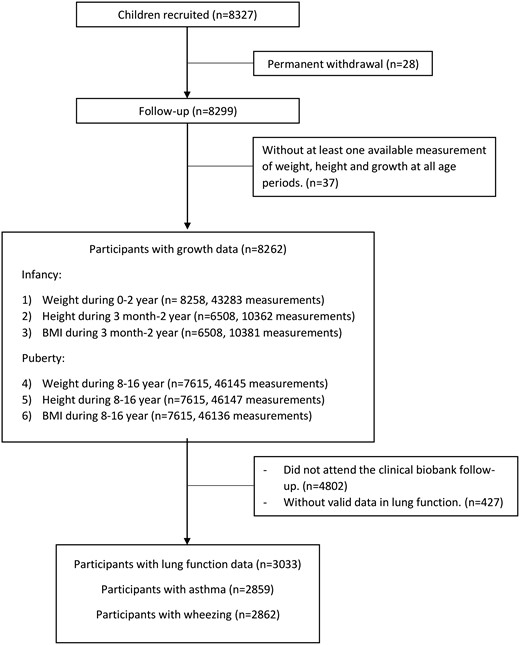
In Hong Kong's 'Children of 1997' Chinese birth cohort (n = 8327), weight during infancy and weight, height and body mass index (BMI) during puberty were modelled using a super-imposition by translation and rotation model to identify (larger or smaller) size, (earlier or later) tempo and (slower or faster) velocity. Sex-specific associations with forced vital capacity (FVC), forced expiratory volume in the first second (FEV1), FEV1/FVC (Global Lung function Initiative z-score) and self-reported wheezing and asthma at ∼17.5 years were assessed.
Results
For each fraction higher than average weight growth velocity during infancy, FVC w as higher in boys (0.90 SD, 95% CI 0.35; 1.44) and girls (0.77 SD, 95% CI 0.24; 1.30), FEV1/FVC was lower (–0.74 SD, 95% CI –1.38; –0.10) and wheezing was higher (odds ratio 6.92, 95% CI 1.60; 29.99) in boys and an inverse association with FVC was observed for tempo but not for size. Associations for weight growth velocity in puberty were similar but weaker. Greater size and higher velocity of BMI growth was associated with higher FVC, lower FEV1/FVC and higher asthma and wheezing risk.
Conclusion
Accelerated infant and pubertal weight growth were associated with disproportionate lung size and airway growth, and higher risk of asthma; optimizing early-life growth patterns could be important.
View on Web

Αρχειοθήκη ιστολογίου