Κυριακή 13 Νοεμβρίου 2022

Evaluating the role of non-alcoholic fatty liver disease in cardiovascular diseases and type 2 diabetes: a Mendelian randomization study in Europeans and East Asians

alexandrossfakianakis shared this article with you from Inoreader

m_dyac212f1.jpeg?Expires=1731265321&Sign

Abstract
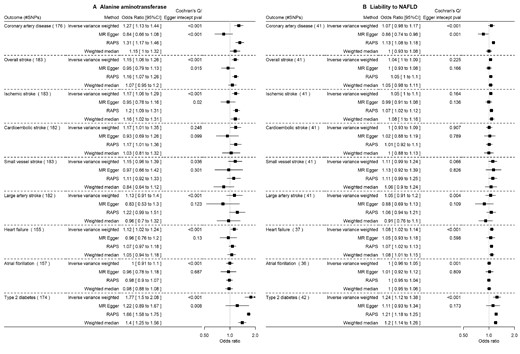
BackgroundWhether non-alcoholic fatty liver disease (NAFLD) causes cardiovascular disease (CVD) and type 2 diabetes (T2D) is unclear and possible differences between ethnicities have not been thoroughly explored. We used Mendelian randomization (MR) to assess the role of NAFLD in CVD and T2D risk in Europeans and East Asians.
Methods
We conducted a MR study using genetic predictors of alanine aminotransferase (ALT), liability to NAFLD, aspartate transaminase (AST), liver magnetic resonance imaging corrected T1 and proton density fat fraction and combined them with genome-wide association studies (GWAS) summary statistics of CVD, T2D and glycaemic traits (sample size ranging from 14 400 to 977 320). Inverse-variance weighted analysis was used to assess the effect of NAFLD in these outcomes, with sensitivity analyses and replication in FinnGen. We conducted analyses in East Asians using ethnicity-specific genetic predictors of ALT and AST, and the respective outcome GWAS summary statistics.
Results
In Europeans, higher ALT was associated with higher T2D risk (odds ratio: 1.77 per standard deviation, 95% CI 1.5 to 2.08), with similar results for other exposures, across sensitivity analyses and in FinnGen. Although NAFLD proxies were related to higher coronary artery disease (CAD) and stroke risk, sensitivity analyses suggested possible bias by horizontal pleiotropy. In East Asians, higher ALT was possibly associated with higher T2D risk, and ALT and AST were inversely associated with CAD.
Conclusions
NAFLD likely increases the risk of T2D in Europeans and East Asians. Potential differential effects on CAD between Europeans and East Asians require further investigation.
View on Web

Neutrophil‐to‐lymphocyte and hypopharyngeal cancer prognosis: System review and meta‐analysis

alexandrossfakianakis shared this article with you from Inoreader

Abstract

Several studies have reported the value of neutrophil-to-lymphocyte ratio (NLR) for the prognosis of hypopharyngeal cancer. However, contradictory findings have also been published. We aimed to clarify the effect of NLR on the prognosis of hypopharyngeal cancer through meta-analysis. Systematic search of PubMed and other database with study selection and data extraction. The combined hazard ratio (HR) and 95% confidence intervals (CI) were calculated using STATA, applying either a fixed-effects or random-effects model. Meta-regression, subgroup analysis, and sensitivity analysis were used to analyze sources of heterogeneity. Publication bias were also assessed. This meta-analysis included 2232 patients with hypopharyngeal cancer from seven studies. The combined HR (OS, HR = 1.80, 95CI%, 1.14–2.82; PFS, HR = 1.88, 95CI%, 1.26–2.79) suggested that high NLR was associated with poor overall survival (OS) and progression-free survival (PFS). Pretreatment NLR can be used as an effective serological indicator to assess the prognosis of patients with hypopharyngeal cancer.

View on Web

Nonpharmaceutical interventions for COVID‐19 disrupt the dynamic balance between influenza A virus and human immunity

alexandrossfakianakis shared this article with you from Inoreader

Abstract

Background

During the COVID-19 epidemic, nonpharmaceutical interventions (NPIs) blocked the transmission route of respiratory diseases. This study aimed to investigate the impact of NPIs on the influenza A virus (IAV) outbreak.

Methods

The present study enrolled all children with respiratory tract infections who came to the Children's Hospital of Zhejiang University between January 2019 and July 2022. A direct immunofluorescence assay kit detected IAV. Virus isolation and Sanger sequencing were performed.

Results

From June to July 2022, in Hangzhou, China, the positive rate of IAV infection in children has increased rapidly, reaching 30.41%, and children over three years old are the main infected population, accounting for 75% of the total number of infected children. Influenza A (H3N2) viruses are representative strains during this period. In this outbreak, H3N2 was isolated from a cluster of its own and is highly homologous with A/South_Dakota /22/2022 (2021-2022 northern hemisphere). Between isolated influenza A(H3N2) viruses and A/South_Dakota/22/2022, the nucleotide homology of the HA gene ranged from 97.3% to 97.5%; the amino acid homology was 97% - 97.2%, and the genetic distance of nucleotides ranged from 0.05 to 0.052. Compared with A/South_Dakota/22/2022, the isolated H3N2 showed S156H, N159Y, I160T, D186S, S198P, I48T, S53D, and K171N mutations. There was no variation in 13 key amino acid sites associated with neuraminidase inhibitor resistance in NA protein.

Conclusion

Long-term NPIs have significantly affected the evolution and transmission of the influenza virus and human immunity, breaking the dynamic balance between the influenza A virus and human immunity.

This article is protected by copyright. All rights reserved.

View on Web

The association between serum 25‐hydroxyvitamin D and the prevalence of herpes simplex virus

alexandrossfakianakis shared this article with you from Inoreader

Abstract

Objective

Previous studies have reported a potential anti-infection effect for vitamin D. However, the relationship between vitamin D status and herpes simplex virus (HSV) infection has not yet been evaluated. Therefore, this study aimed to determine the association between serum 25-hydroxyvitamin D [25(OH)D] and infection with HSV types 1 and 2 (HSV-1 and HSV-2).

Methods

Data were collected from the National Health and Nutrition Examination Survey (NHANES) from 2007-2016. The association between 25(OH)D and HSV prevalence was evaluated using propensity score matching (PSM) and univariate and multivariate logistic regression analyses.

Results

Overall, 14174 participants were included in the final analysis. Before PSM, 8639 (60.9%) had positive HSV-1 and 2636 (18.6%) had HSV-2. The HSV-1 and HSV-2 positive groups had more females and older individuals (P<0.05). The HSV-2 patients had lower 25(OH)D levels than those with HSV-1. Age and g ender did not differ in the groups after PSM (P>0.05). The 25(OH)D level was significantly lower in the HSV-1 and HSV-2 groups than in the non-HSV infection groups. Multivariate logistic regression showed that serum 25(OH)D level was negatively associated with HSV-1 and HSV-2 infection (OR=0.730 and 0.691, P<0.001, respectively). Vitamin D deficiency was an independent risk factor for both HSV-1 and HSV-2 (adjusted OR=2.205 and 2.704, P<0.001, respectively).

Conclusion

Lower serum 25(OH)D levels correlated significantly with increased HSV-1 and HSV-2 infection risk

This article is protected by copyright. All rights reserved.

View on Web

Transplacental transmission of SARS‐CoV‐2 immunoglobulin G antibody to infants from maternal COVID‐19 vaccine immunization before pregnancy

alexandrossfakianakis shared this article with you from Inoreader

Abstract

Background & aim

Coronavirus disease 2019 (COVID-19) vaccine generates functional antibodies in maternal circulation that are detectable in infants, while the information is restricted to the usage of COVID-19 vaccine during pregnancy. In this study, we aimed to evaluate the effect of maternal COVID-19 vaccines before pregnancy.

Method

Infants were included from mothers with no inactivated COVID-19 vaccine, 1-dose, 2-dose and 3-dose before pregnancy, and SARS-CoV-2 IgG antibodies were tested. Comparative analysis was done between the groups.

Results

A total of 130 infants were enrolled in the study. Significantly higher levels of SARS-CoV-2 IgG antibodies in infants born to mothers with 3-dose COVID-19 vaccine before pregnancy compared with 1-dose and 2-dose groups (p<0.0001). The levels of antibodies decreased significantly with age in infants born to mothers with the 3-dose COVID-19 vaccine before pregnancy (r=-0.338, p=0.035), and it w as still higher than that 2-dose COVID-19 vaccine group.

Conclusion

The maternal SARS-CoV-2 antibodies produced from the inactivated COVID-19 vaccine before pregnancy can be transferred to newborns via the placenta. Maternal immunization with 3-dose of the COVID-19 vaccine before pregnancy could be more beneficial for both mothers and infants.

This article is protected by copyright. All rights reserved.
View on Web

The widest use of paracetamol in home therapy might have actually increased the occurrence of severe forms of COVID‐19 in Italy, affecting hospitalization and death rates.

alexandrossfakianakis shared this article with you from Inoreader

Abstract

A recent contribution by Perico et al., recommended the use of Non-Steroidal Anti-Inflammatory Drugs (NSAIDs) in the early stage of SARS-CoV2 infection, preventing the onset of a severe form of COVID-19 and hence reducing the hospitalization rate and the risk of mortality 1. Many previous reports from the same group 2-3 and from ours 4, showed that the use of paracetamol, as recommended by the Italian Ministry of Health since Nov 30 th 2020, usually associated with the advice to monitor one's own developing symptoms at home ("watchful waiting"), increased the risk to be hospitalized.

This article is protected by copyright. All rights reserved.

View on Web

Drilling‐ and withdrawing‐related thermal effects of implant site preparation for ceramic and stainless steel twist drills in standardized bovine bone

alexandrossfakianakis shared this article with you from Inoreader

Abstract

Introduction

Excessive surgical trauma is believed to be among the most important causes for early implant losses. As thermal injury to the bone is not only dependent on the amount of generated heat but also on the tissue exposure time, and the greatest temperature increase was found within the withdrawing period, the entire osteotomy procedure with the parameters contributing to thermal damage is of particular clinical relevance. The aim of this study was to investigate the thermal performance of metal-based and ceramic implant drills regarding the temperature exposure time during the whole osteotomy process.

Materials and Methods

This investigation consisted of 240 individual preparations in total, comprising two different drilling depths (10 and 16 mm), two irrigation methods (external and without irrigation), two implant drill materials (stainless steel and zirconia), and three consecutive drill diameters per material (2.0/2.2, 2.8, and 3.5 mm) with 10 identical repetitions. Real-time multichannel temperature measurement was conducted during automated drilling procedures in standardized bovine bone specimens.

Results

The maximum temperature changes were highly associated with the time period of passive drill withdrawing (p ≤ 0.05), irrespective of drill material, drilling depth, or drill diameter. Statistically significant differences in temperature generation between stainless steel and ceramic drills were observed in irrigated testing sites at both drilling depths with smaller drill diameters (2.0/2.2 and 2.8 mm, p ≤ 0.05).

Conclusion

Results of this in vitro study could demonstrate a strong association between the highest temperature increase and the passive withdrawing time period in both investigated drill materials. Considering these findings and the resulting thermal bone damage due to the whole surgical procedure, high overall temperatures in combination with a prolonged heat exposure time may impact the future osseointegration process.

View on Web

Αρχειοθήκη ιστολογίου