

Πληροφορίες
Κυριακή 22 Μαρτίου 2020
Helicobacter pylori CagA oncoprotein interacts with SHIP2 to increase its delivery into gastric epithelial cells
Helicobacter pylori CagA oncoprotein interacts with SHIP2 to increase its delivery into gastric epithelial cells:

MRI Assessment of Swallow Muscle Activation with the Swallow Exercise Aid and with Conventional Exercises in Healthy Volunteers: An Explorative Biomechanical Study
MRI Assessment of Swallow Muscle Activation with the Swallow Exercise Aid and with Conventional Exercises in Healthy Volunteers: An Explorative Biomechanical Study:

Abstract
Swallowing muscle strength exercises are effective in restoring swallowing function. In order to perform the exercises with progressive load, the swallow exercise aid (SEA) was developed. Precise knowledge on which muscles are activated with swallowing exercises, especially with the SEA, is lacking. This knowledge would aid in optimizing the training program to target the relevant swallowing muscles, if necessary. Three healthy volunteers performed the three SEA exercises (chin tuck against resistance, jaw opening against resistance and effortful swallow) and three conventional exercises [conventional effortful swallow (cES), Shaker and Masako] in supine position inside an MRI scanner. Fast muscle functional MRI scans (generating quantitative T2-maps) were made immediately before and after the exercises. Median T2 values at rest and after exercise were compared to identify activated muscles. After the three SEA exercises, the suprahyoid, infrahyoid, sternocleidomastoid, and lateral pterygoid muscles showed significant T2 value increase. After the Shaker, the lateral pterygoid muscles did not show such an increase, but the three other muscle groups did. The cES and Masako caused no significant increase in any of these muscle groups. During conventional (Shaker) exercises, the suprahyoid, infrahyoid, and sternocleidomastoid muscles are activated. During the SEA exercises, the suprahyoid, infrahyoid, sternocleidomastoid, and lateral pterygoid muscles are activated. The findings of this explorative study further support the potential of the SEA to improve swallowing rehabilitation.EGFR mutation and HPV infection in sinonasal inverted papilloma and squamous cell carcinoma.
EGFR mutation and HPV infection in sinonasal inverted papilloma and squamous cell carcinoma.:
EGFR mutation and HPV infection in sinonasal inverted papilloma and squamous cell carcinoma.
Rhinology. 2020 Mar 21;:
Authors: Cabal VN, Menendez M, Vivanco B, Potes-Ares S, Riobello C, Suarez-Fernandez L, Garcia-Marin R, Blanco-Lorenzo V, Lopez F, Alvarez-Marcos C, Llorente JL, Hermsen MA
Abstract
BACKGROUND: To evaluate the involvement of EGFR signalling and HPV infection in a cohort of inverted sinonasal papilloma (ISP) and sinonasal squamous cell carcinoma (SNSCC) and their value for prognosis and clinical treatment.
METHODS: We analysed 55 ISP, 14 SNSCC associated with ISP (SNSCC-isp) and and 60 SNSCC not associated with ISP (SNSCC-novo) for EGFR gene mutation and copy number gain, protein expression of EGFR and phosporylated EGFR (pEGFR), and HPV-infection and KRAS mutation. Findings were correlated to clinico-pathological and follow-up data.
RESULTS: We found EGFR exon 20 mutations in 38% (7/18) ISP, in 50% (6/12) SNSCC-isp and in 5% (1/19) SNSCC-novo. EGFR was expressed in 92% of ISP, while pEGFR was observed in 54% (21/39). SNSCC-isp and SNSCC-novo demonstrated comparable expression of EGFR (57% and 33%) and of pEGFR (44% and 38%). We observed an inverse relation between EGFR exon 20 mutation and pEGFR expression. Four of 39 (10%) ISP carried HPV-16. Oncogenic HPV was detected in 3/12 (25%) SNSSC-isp and in 1/8 (13%) SNSCC-novo. KRAS mutations were not detected in any of the samples. HPV infection was inversely correlated with pEGFR expression but not with EGFR mutation. ISP with EGFR activation by mutation or by phosphorylation had longer ISP-free survival, however, neither EGFR exon 20 mutation, pEGFR expression nor HPV infection demonstrated prognostic value in SNSCC.
CONCLUSIONS: EGFR exon 20 mutation is frequent in ISP and SNSCC-isp, while activation of EGFR through phosphorylation also plays an important role. Our data indicate that a large proportion of SNSCC patients could benefit from therapy with modern EGFR inhibitors.
PMID: 32199023 [PubMed - as supplied by publisher]
| Related Articles |
Rhinology. 2020 Mar 21;:
Authors: Cabal VN, Menendez M, Vivanco B, Potes-Ares S, Riobello C, Suarez-Fernandez L, Garcia-Marin R, Blanco-Lorenzo V, Lopez F, Alvarez-Marcos C, Llorente JL, Hermsen MA
Abstract
BACKGROUND: To evaluate the involvement of EGFR signalling and HPV infection in a cohort of inverted sinonasal papilloma (ISP) and sinonasal squamous cell carcinoma (SNSCC) and their value for prognosis and clinical treatment.
METHODS: We analysed 55 ISP, 14 SNSCC associated with ISP (SNSCC-isp) and and 60 SNSCC not associated with ISP (SNSCC-novo) for EGFR gene mutation and copy number gain, protein expression of EGFR and phosporylated EGFR (pEGFR), and HPV-infection and KRAS mutation. Findings were correlated to clinico-pathological and follow-up data.
RESULTS: We found EGFR exon 20 mutations in 38% (7/18) ISP, in 50% (6/12) SNSCC-isp and in 5% (1/19) SNSCC-novo. EGFR was expressed in 92% of ISP, while pEGFR was observed in 54% (21/39). SNSCC-isp and SNSCC-novo demonstrated comparable expression of EGFR (57% and 33%) and of pEGFR (44% and 38%). We observed an inverse relation between EGFR exon 20 mutation and pEGFR expression. Four of 39 (10%) ISP carried HPV-16. Oncogenic HPV was detected in 3/12 (25%) SNSSC-isp and in 1/8 (13%) SNSCC-novo. KRAS mutations were not detected in any of the samples. HPV infection was inversely correlated with pEGFR expression but not with EGFR mutation. ISP with EGFR activation by mutation or by phosphorylation had longer ISP-free survival, however, neither EGFR exon 20 mutation, pEGFR expression nor HPV infection demonstrated prognostic value in SNSCC.
CONCLUSIONS: EGFR exon 20 mutation is frequent in ISP and SNSCC-isp, while activation of EGFR through phosphorylation also plays an important role. Our data indicate that a large proportion of SNSCC patients could benefit from therapy with modern EGFR inhibitors.
PMID: 32199023 [PubMed - as supplied by publisher]
Cancers, Vol. 12, Pages 753: Molecular Profiling for Predictors of Radiosensitivity in Patients with Breast or Head-and-Neck Cancer
Cancers, Vol. 12, Pages 753: Molecular Profiling for Predictors of Radiosensitivity in Patients with Breast or Head-and-Neck Cancer:
Cancers, Vol. 12, Pages 753: Molecular Profiling for Predictors of Radiosensitivity in Patients with Breast or Head-and-Neck Cancer
Cancers doi: 10.3390/cancers12030753
Authors:
Kimi Drobin
Michal Marczyk
Martin Halle
Daniel Danielsson
Anna Papiez
Traimate Sangsuwan
Annika Bendes
Mun-Gwan Hong
Ulrika Qundos
Mats Harms-Ringdahl
Peter Wersäll
Joanna Polanska
Jochen M. Schwenk
Siamak Haghdoost
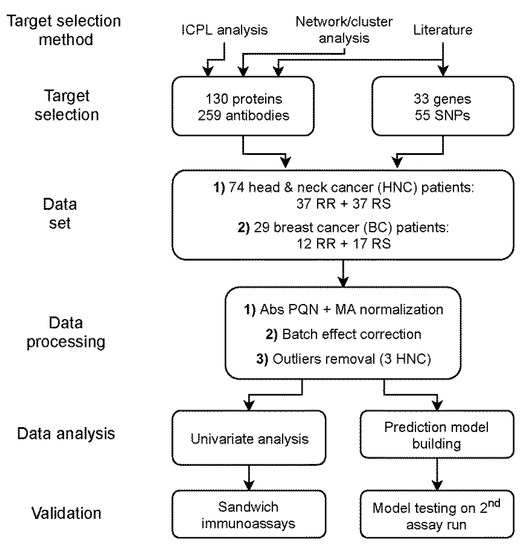
Nearly half of all cancers are treated with radiotherapy alone or in combination with other treatments, where damage to normal tissues is a limiting factor for the treatment. Radiotherapy-induced adverse health effects, mostly of importance for cancer patients with long-term survival and may appear during or long time after finishing radiotherapy, are depending on the patient radiosensitivity. Currently, there is no assay available that can reliably predict the individual’s response to radiotherapy. In the present study, we profiled two radiosensitive study sets from breast (n = 29) and head-and-neck cancer patients (n = 74) that included patients and matched radioresistant controls. We studied 55 single nucleotide polymorphisms (SNPs) in 33 genes by DNA genotyping and 130 circulating proteins by affinity-based plasma proteomics. In both study sets, we discovered several plasma proteins with the predictive power to find radiosensitive patients (adjusted p < 0.05) and validated the two most predictive proteins (THPO and STIM1) by sandwich immunoassays. By integrating genotypic and proteomic data into an analysis model, it was found that the proteins CHIT1, PDGFB, PNKD, RP2, SERPINC1, SLC4A, STIM1, and THPO, as well as the VEGFA gene variant rs69947, predicted radiosensitivity of our breast cancer (AUC = 0.76) and head-and-neck cancer (AUC = 0.89) patients. In conclusion, circulating proteins and a SNP variant of VEGFA suggests that processes such as vascular growth capacity, immune response, DNA repair and oxidative stress/hypoxia may be involved in an individual’s risk of experiencing radiation-induced toxicity.
Cancers, Vol. 12, Pages 753: Molecular Profiling for Predictors of Radiosensitivity in Patients with Breast or Head-and-Neck Cancer
Cancers doi: 10.3390/cancers12030753
Authors:
Kimi Drobin
Michal Marczyk
Martin Halle
Daniel Danielsson
Anna Papiez
Traimate Sangsuwan
Annika Bendes
Mun-Gwan Hong
Ulrika Qundos
Mats Harms-Ringdahl
Peter Wersäll
Joanna Polanska
Jochen M. Schwenk
Siamak Haghdoost
Nearly half of all cancers are treated with radiotherapy alone or in combination with other treatments, where damage to normal tissues is a limiting factor for the treatment. Radiotherapy-induced adverse health effects, mostly of importance for cancer patients with long-term survival and may appear during or long time after finishing radiotherapy, are depending on the patient radiosensitivity. Currently, there is no assay available that can reliably predict the individual’s response to radiotherapy. In the present study, we profiled two radiosensitive study sets from breast (n = 29) and head-and-neck cancer patients (n = 74) that included patients and matched radioresistant controls. We studied 55 single nucleotide polymorphisms (SNPs) in 33 genes by DNA genotyping and 130 circulating proteins by affinity-based plasma proteomics. In both study sets, we discovered several plasma proteins with the predictive power to find radiosensitive patients (adjusted p < 0.05) and validated the two most predictive proteins (THPO and STIM1) by sandwich immunoassays. By integrating genotypic and proteomic data into an analysis model, it was found that the proteins CHIT1, PDGFB, PNKD, RP2, SERPINC1, SLC4A, STIM1, and THPO, as well as the VEGFA gene variant rs69947, predicted radiosensitivity of our breast cancer (AUC = 0.76) and head-and-neck cancer (AUC = 0.89) patients. In conclusion, circulating proteins and a SNP variant of VEGFA suggests that processes such as vascular growth capacity, immune response, DNA repair and oxidative stress/hypoxia may be involved in an individual’s risk of experiencing radiation-induced toxicity.
SONO case series: a 63-year-old male with shortness of breath
SONO case series: a 63-year-old male with shortness of breath:

Case presentation
A 63-year-old, undomiciled male, who has been out of care for many years presents with shortness of breath for the last 3 days. He has also had 3 days of constant, substernal chest tightness which is not pleuritic, positional or exertional. He has a chronic cough with some worsening yellow sputum production but no fevers. He denies leg swelling. He is an active smoker with a 40 pack-year history. He has a history of alcohol abuse and methamphetamine abuse. His EKG does not show any acute ischaemia.
Initial vital signs
BP 135/96, pulse 121, RR 28, temperature 36.3, oxygen saturation 95% on room air.
The patient is tachypnoeic. His heart sounds are notable for tachycardia without murmurs, gallop or rubs. His lung sounds are notable for both wheeze and rales at the bases. His abdomen is soft and non-distended and non-tender, and his extremities are warm and well perfused without...
Case presentation
A 63-year-old, undomiciled male, who has been out of care for many years presents with shortness of breath for the last 3 days. He has also had 3 days of constant, substernal chest tightness which is not pleuritic, positional or exertional. He has a chronic cough with some worsening yellow sputum production but no fevers. He denies leg swelling. He is an active smoker with a 40 pack-year history. He has a history of alcohol abuse and methamphetamine abuse. His EKG does not show any acute ischaemia.
Initial vital signs
BP 135/96, pulse 121, RR 28, temperature 36.3, oxygen saturation 95% on room air.
The patient is tachypnoeic. His heart sounds are notable for tachycardia without murmurs, gallop or rubs. His lung sounds are notable for both wheeze and rales at the bases. His abdomen is soft and non-distended and non-tender, and his extremities are warm and well perfused without...
Challenges of pesticide exposure assessment in occupational studies of chronic diseases
Challenges of pesticide exposure assessment in occupational studies of chronic diseases:

In this issue of Occupational and Environmental Medicine, Ohlander and colleagues review methods used to assess pesticide exposure in occupational epidemiology studies over the last 25 years .1 Their findings are striking for two reasons. The first is the very large number of studies published during this time period. Pesticides have been linked to almost every category of chronic disease, including cancer, respiratory, neurological and autoimmune diseases, as well as reproductive outcomes. The authors identified 1271 articles, averaging over 50 publications per year. Second, as the authors note, the methods used to assign pesticide exposure are relatively crude in many instances, limiting the aetiological inferences that can be made from these data.
Pesticide exposure is ubiquitous not only in occupational settings but also in the environment. Worldwide, in 2012, the last year for which data are available, almost six billion pounds of pesticide active ingredients were applied.2 These...
In this issue of Occupational and Environmental Medicine, Ohlander and colleagues review methods used to assess pesticide exposure in occupational epidemiology studies over the last 25 years .1 Their findings are striking for two reasons. The first is the very large number of studies published during this time period. Pesticides have been linked to almost every category of chronic disease, including cancer, respiratory, neurological and autoimmune diseases, as well as reproductive outcomes. The authors identified 1271 articles, averaging over 50 publications per year. Second, as the authors note, the methods used to assign pesticide exposure are relatively crude in many instances, limiting the aetiological inferences that can be made from these data.
Pesticide exposure is ubiquitous not only in occupational settings but also in the environment. Worldwide, in 2012, the last year for which data are available, almost six billion pounds of pesticide active ingredients were applied.2 These...
Estimating 42 pesticide sampling rates by POCIS and POCIS-MIP samplers for groundwater monitoring: a pilot-scale calibration
Estimating 42 pesticide sampling rates by POCIS and POCIS-MIP samplers for groundwater monitoring: a pilot-scale calibration:
Abstract
Pesticides occur in groundwater as a result of agricultural activity. Their monitoring under the Water Framework Directive is based on only a few spot-sampling measurements per year despite their temporal variability. Passive sampling, which was successfully tested in surface water to provide a more representative assessment of contamination, could be applied to groundwater for a better definition of its contamination. However, few reliable calibration data under low water flow are available. The objective of our study thus consisted in determining sampling rates by two types of passive samplers, a POCIS (polar organic chemical integrative sampler) for polar pesticides, and a POCIS-MIP sampler based on a receiving phase of molecular imprinted polymers, specific for AMPA and glyphosate under low flow conditions as exist in groundwater. To our knowledge, this is the first time that sampling rates (sampling rate represents the volume of water from which the analyte is quantitatively extracted by the sampler per unit time) are estimated for groundwater applications. Our calibrations took place in an experimental pilot filled with groundwater and with low water flow (a few metres per day). Pesticide uptake in POCIS showed good linearity, with up to 28 days before reaching equilibrium. Two types of accumulation in POCIS were noted (a linear pattern up to 28 days, and after a time lag of 7 to 14 days). Sampling rates for 38 compounds were calculated and compared with those available in the literature or obtained previously under laboratory conditions. The values obtained were lower by a factor 1 to 14 than those estimated under stirring conditions in the literature, whereas water flow velocity (m s−1) differed by a factor of 2000 to 10,000.
Εγγραφή σε:
Αναρτήσεις (Atom)